Finance Skills Showcase
What Anthropic’s financial-services Claude Code plugins actually produce when you run them on real companies — and what happens when you fact-check the output.
What the skills produce
Each card is one skill or named agent showing what it actually outputs. Scroll horizontally or use the arrows. Tap any card to read the full output.
/screen — idea-generationRun a quantitative screen on a universe; output a ranked shortlist with one-line theses, key risks, and data quality flags.
Top 3 from a deep-value telecom screen — anchored on Vodafone
- TelefónicaEV/EBITDA 4.2x · 8% div · Spain ARPU stabilising
- OrangeEV/EBITDA 3.4x · LatAm + Africa optionality
- ProximusEV/EBITDA 3.2x · 17% optical yield (verify coverage)
84-name universe · 18 hits · 2 excluded for data quality
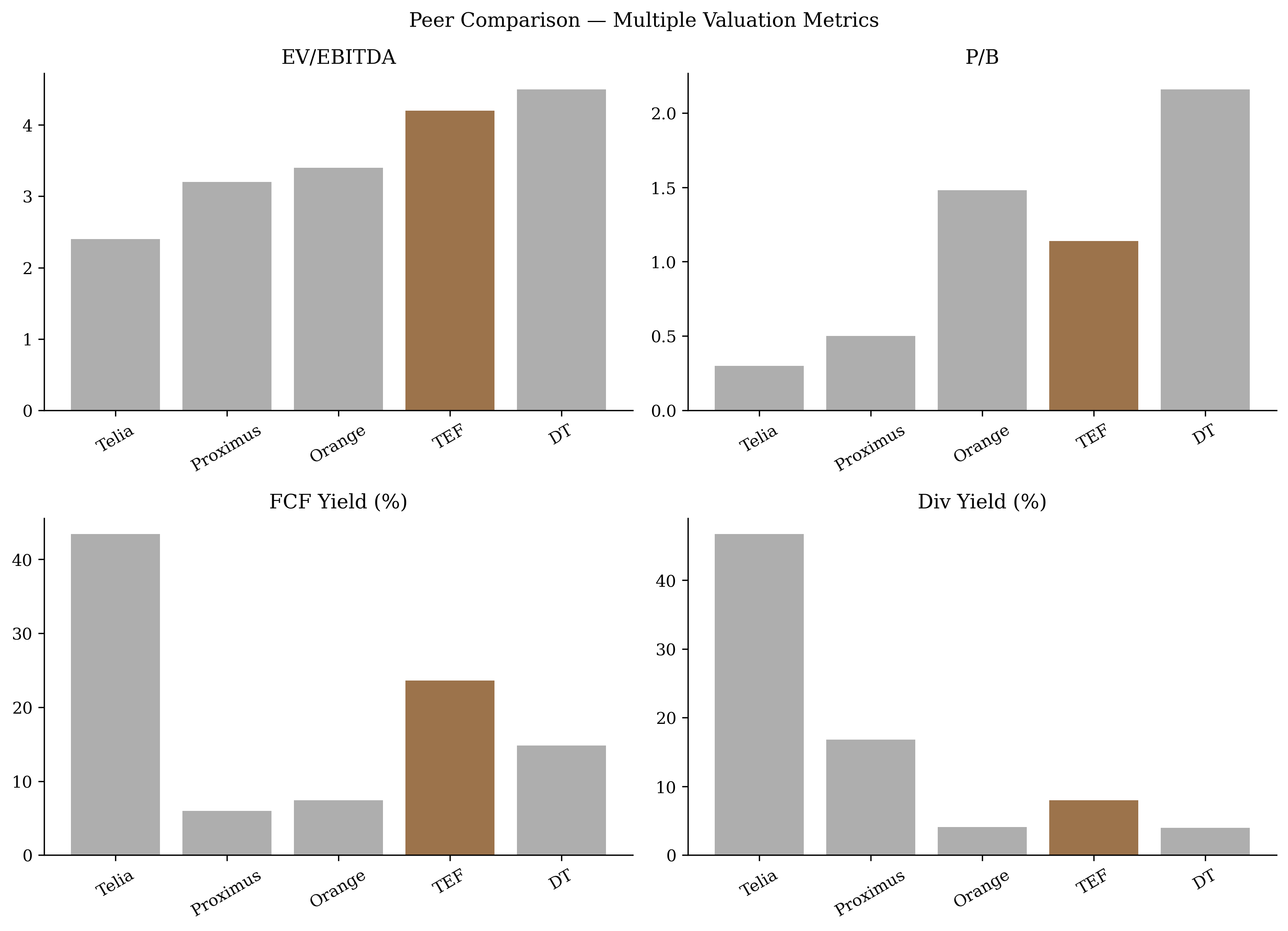
/comps — comparable companiesBuild a peer multiples table with statistical bands (min / 25th / median / 75th / max) and the target company highlighted.
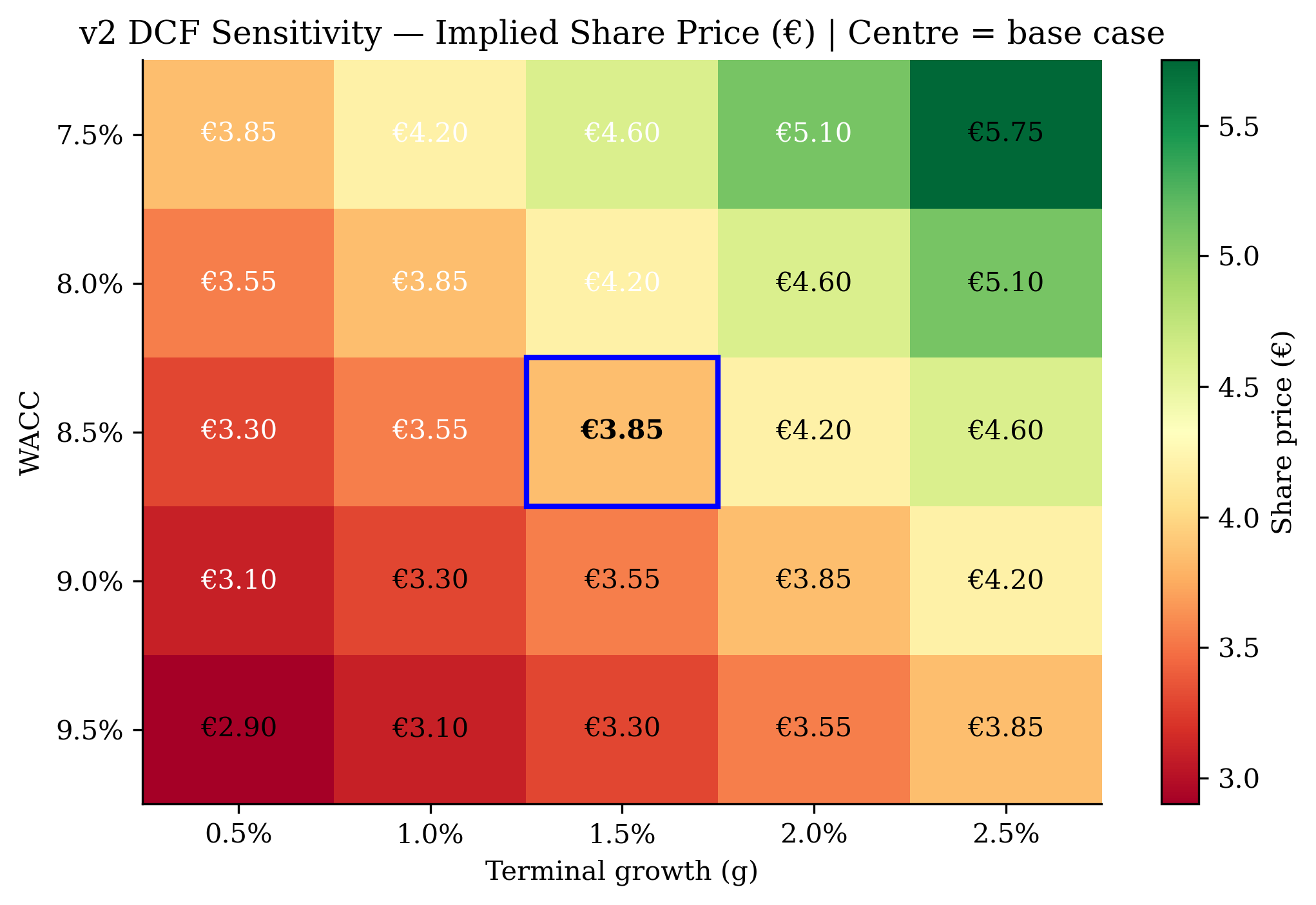
/dcf — discounted cash flowBuild a DCF in Excel with sensitivity tables, anchored on company FCF guidance. Formulas, not hardcodes; sensitivity over WACC × terminal growth.
/thesis — thesis trackerMaintain a falsifiable investment thesis with pillars, status, catalysts, and a dated update log. Pillars must be testable.
Telefónica — five-pillar thesis (v2, May 2026)
- 1Spain delivers organicallyConfirmed
- 2Brazil (Vivo) compoundsConfirmed
- 3Capital allocation reset funds deleveragingOn track
- 4Plan execution drives multiple expansionWatch
- 5Strategic optionality preserved (narrowed)Watch
Conviction: Medium · 14 May 2026 print is the first data point
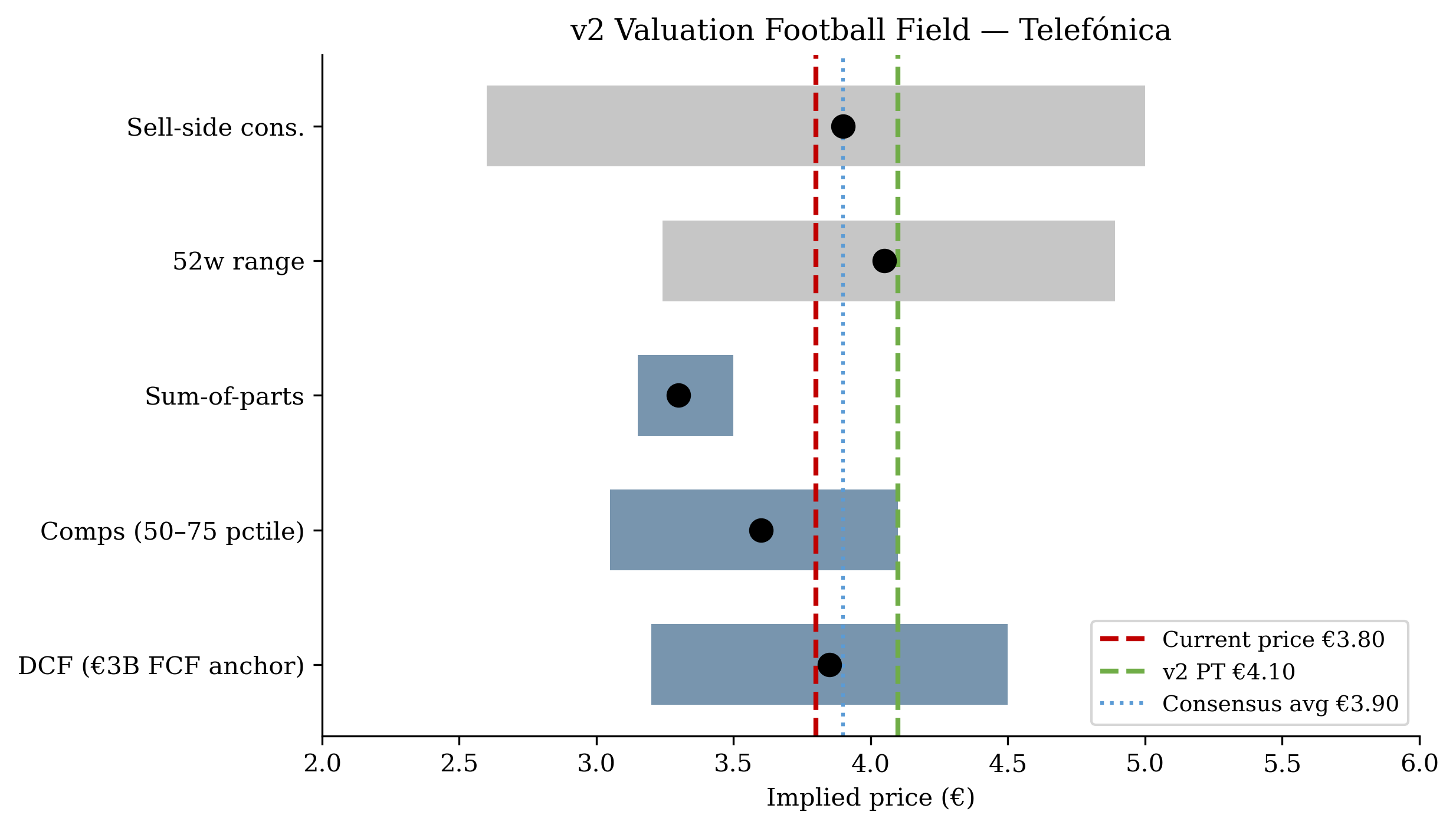
/initiate — initiating coverageFive-task pipeline: research doc, financial model, valuation, charts, final report. Click to read the 30-page PDF in the browser — Times New Roman, 16 embedded charts, full cover.
earnings-reviewer (named agent)Wraps four skills into a post-print workflow. Produces a variance table, model update, and note draft for the senior analyst to review.
Vodafone Q3 FY26 — variance check
| Group revenue | €10.5bn | +6.5% YoY |
| Service revenue | €8.5bn | +7.3% YoY |
| EBITDAaL (YTD) | €8.5bn | +5.3% YoY |
| FY26 guidance | Reaffirmed | Upper end |
| DPS FY26 | +2.5% | First raise in 8yrs |
Plus: post-print event (CK Hutchison VodafoneThree £4.3bn buyout)
/audit — audit-xlsRun a structured QC pass on a financial model — balance checks, formula errors, hardcodes in calc rows, model-type-specific bugs.
v2 model audit — 3 critical findings
- C1Balance sheet doesn't enforce Total Assets = Total Liabilities + Equity
- C2Cash doesn't tie between Cash Flow and Balance Sheet
- C3Unlevered FCF mismatch in DCF (levered FCF discounted at WACC)
Plus 32 warnings · 19 info · 975 cells walked across 10 tabs
/sector — sector overviewMap the sector — TAM, structure, key players, valuation context, and the live debates. Pairs naturally with idea-generation as a framing artifact.
European Telecom Services — landscape (May 2026)
- Universe
- 7 large-cap incumbents (DTE, TEF, ORA, VOD, BT, TELIA, PROX)
- Sector multiple
- EV/EBITDA median 3.4× — near decade lows
- 2025–26 theme
- Capital allocation reset wave (TEF + VOD dividend cuts)
- Best risk/reward
- TEF and Orange — operational delivery + reset
- Cleanest setup
- Vodafone — Della Valle simplification largely done
Key debate: terminal multiple compression vs cyclical
/catalysts — catalyst calendarForward-looking events table for a coverage basket — earnings dates, AGMs, regulatory decisions, macro releases — with H/M/L impact ratings and positioning notes.
Coverage basket — next 30 days
- 14 MayTelefónica Q1 2026 resultsHigh
- 15 MayBerkshire Hathaway AGMMedium
- 20 MayVodafone FY26 resultsHigh
- 3 JunTelefónica AGM (STC vote)Medium
- 10 JunECB rate decisionHigh
- Jun 2026VMO2 lock-up expiresHigh
Plus weekly preview format and 30-day forward look
/earnings — earnings analysisPost-print quarterly update — beat/miss table, drivers, updated estimates, valuation impact, thesis check. Targets an 8–12 page DOCX with citations and charts.
Microsoft Q3 FY26 — beat / miss (illustrative)
| Revenue ($B) | 71.2 | 69.8 | +$1.4B |
| Op income ($B) | 32.5 | 31.4 | +$1.1B |
| EPS ($) | 3.32 | 3.20 | +$0.12 |
| Azure growth (cc) | 30% | 28% | +200bps |
| Capex ($B) | 21.0 | 19.5 | +$1.5B |
Mgmt lifted FY26 capex guide; AI gross margin “approaching software-like”
On 5 May 2026 Anthropic announced ten ready-to-run agent templates for financial services work — pitchbooks, KYC, month-end close, equity research initiations, earnings updates, and more. You download them as Claude Code plugins, structured around skills (workflow knowledge), commands (slash-shortcuts), and named agents (system prompts that orchestrate skills).
Over the past year or so I have been playing round with agents to see how far they could get in producing equity research, so was keen to see what Claude's out-of-the-box solutions would produce. What follows is what was produced after downloading the equity-research and financial-analysis bundles and putting them to work on some real companies. I followed a basic format which may be followed in an equity research department - get a quick first pass at the problem, get the output checked by another agent, then re-run with feedback from that check. This piece walks through what came out at each step.
To be upfront, I have reached the conclusion that AI generated research is useful but not a replacement for human research and decision making. The ability to be able to run significant amounts of research at speed, built on top of exisitng data you own (or data the agent retrieves from filings) should be a massive positive.
Chapters
- 01
The plugin system
What Anthropic shipped, how it's structured, what skills are available
- 02
A first look at the skills
Ten single-skill outputs run on a value-tilted basket — what each one produces in isolation
- 03
The full initiation pipeline
Running all five tasks of the initiating-coverage skill end-to-end on Telefónica
- 04
Reality check
Validating the institutional-looking output against live data and primary filings
- 05
Production v2 — with discipline
Re-running the same pipeline with WebSearch forced upfront — and watching the answer change
- 06
The supporting cast
Audit-xls, the earnings-reviewer agent, and the pitchbook author tested against real artifacts
- 07
What this means for practitioners
Pros, cons, and approaches for using these skills in real workflows
How to read this
Each chapter has the same shape: a short technical explanation of how the skill or component works (supported by Claude’s explanations!), the actual outputs it produced (readable in the browser, with key extracts inline), and a section for my own commentary on where it lands for practitioners. You can read straight through or jump to whichever component you care about — the chapters cross-reference each other.
Markdown outputs are formatted for browser reading. Excel models, Word reports, and the PowerPoint deck are downloadable as native files for those who want to open them in their own tools.