Production v2 — with discipline
The same pipeline, run with WebSearch forced upfront. The structure remains the same but the answer changes.
How it works
v2 is the same skills, the same workflow, the same target company. What changes is the discipline imposed at the start: every backward-looking specific fact is web-searched and verified before any drafting begins. The output is a facts pack — a single document with every number, date, and claim used downstream cited to a primary source.
The investment of time is real. Roughly forty-five minutes of focused web research before any narrative or model work. Twelve web searches in this case, covering: current price and market cap, FY24 and FY25 actuals, the Transform & Grow strategic plan announcement, dividend status, management transitions, STC stake, Hispam exit pace, VMO2 status, sector-level news flow, sell-side consensus, segment performance, and the company-reported FCF / leverage definitions.
The skill itself didn’t force this discipline. The initiating-coverage SKILL.md has no upfront cutoff guard — I had to request it to get this response after seeing and checking the output of the first version. But once the facts pack exists, every chapter of the v2 is anchored to it: the research doc, the financial model, the valuation, the charts, the DOCX.
What changed
| v1 (no upfront search) | v2 (WebSearch first) | |
|---|---|---|
| Recommendation | BUY | HOLD |
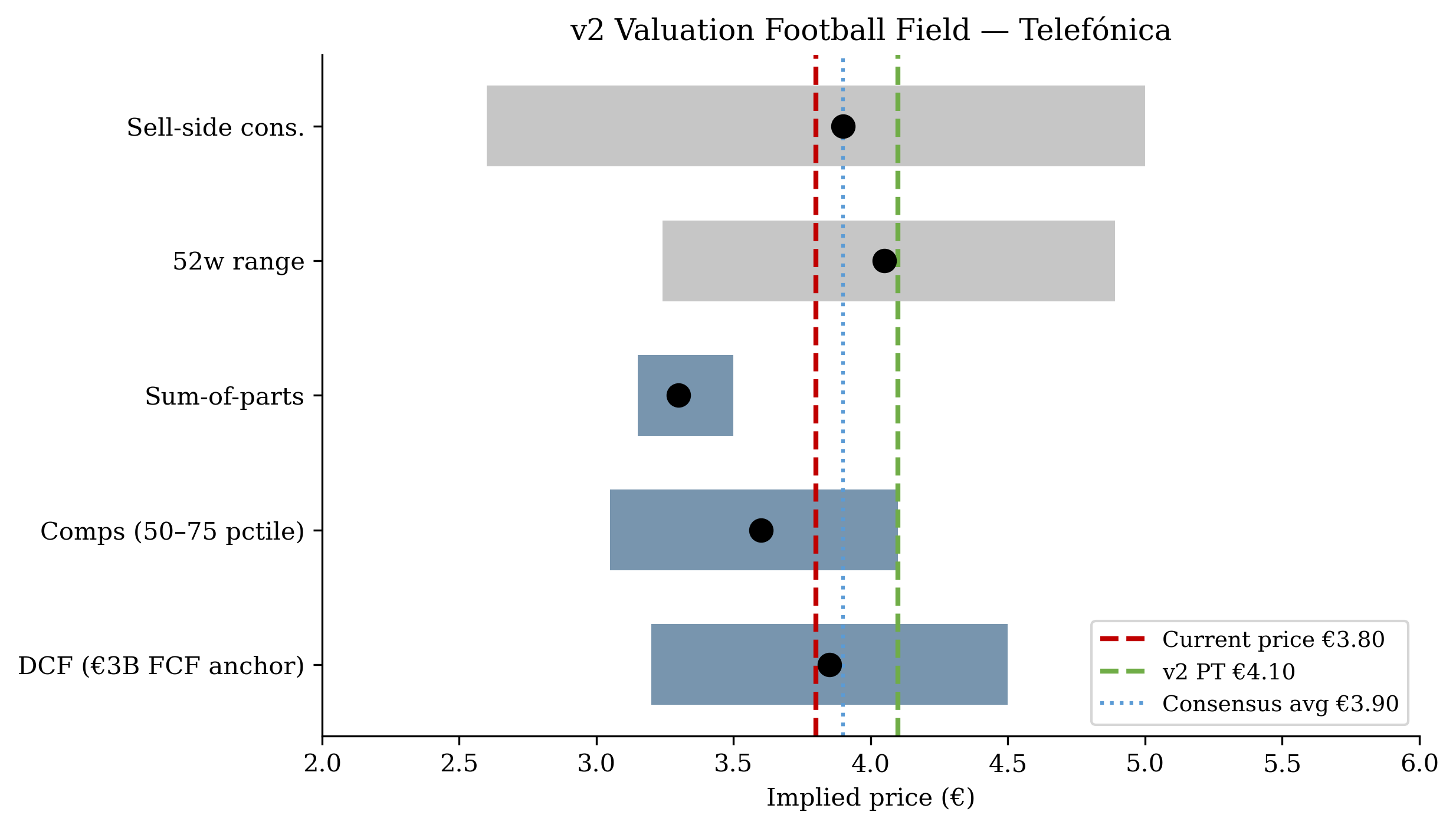
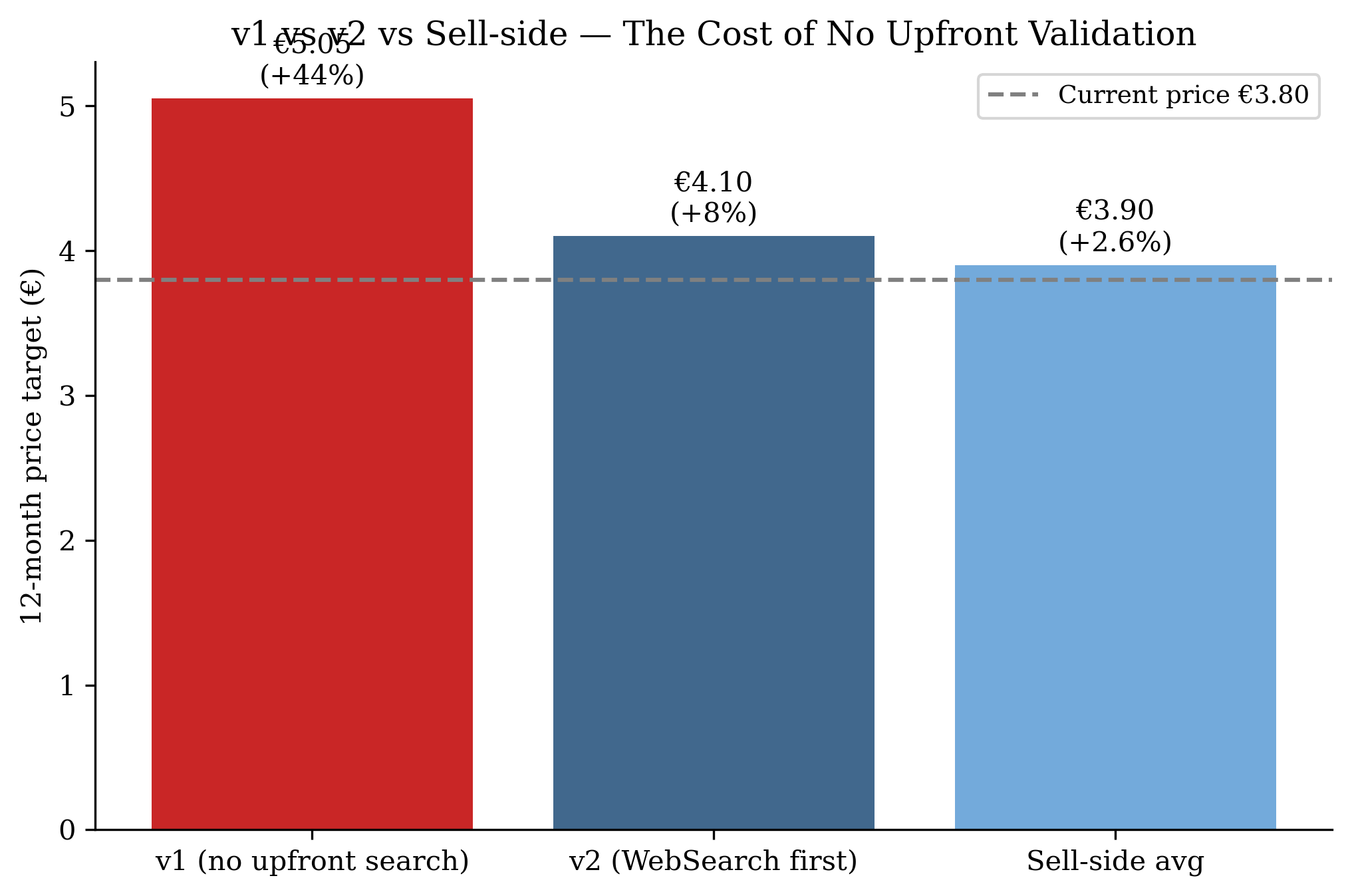
| Price target | €5.05 | €4.10 |
| Upside | +44% | +8% |
| Total return (PT + yield) | ~52% | ~12% |
| Position vs consensus | Top of range | At consensus mid +€0.20 |
| Sources cited | 1 (EODHD pull) | 25 |
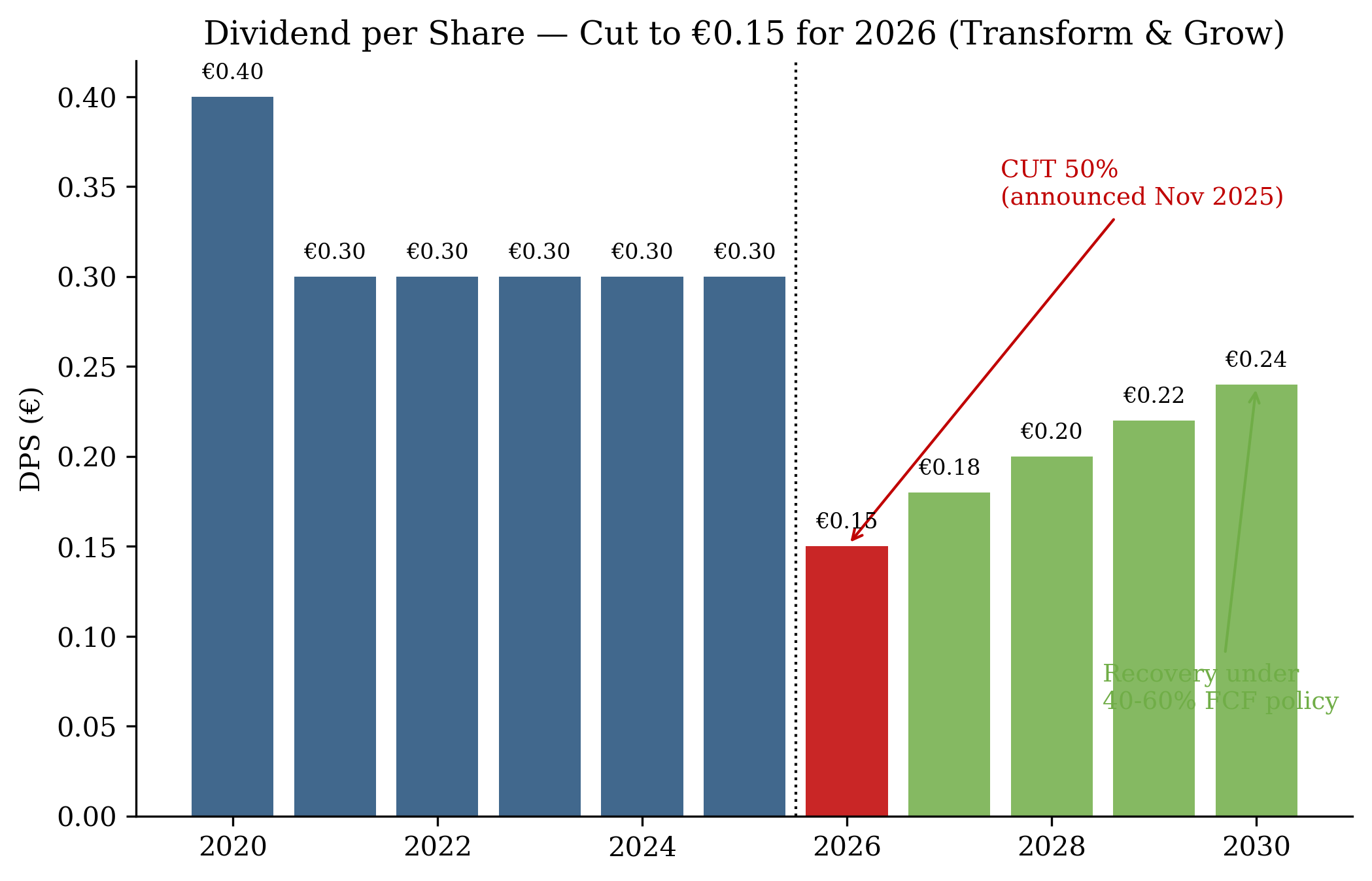
| Dividend in thesis | Pillar 4 — covered 8% carry | Removed; cut already happened |
The recommendation flipped from BUY/+44% to HOLD/+8% as teh inputs changed. The structural framework — peer set, valuation method blend, thesis architecture, risk taxonomy — transferred unchanged.
The thesis pivot
v1 — deep-value yield carry
- 1. Spain ARPU stabilises post-MasOrange
- 2. LatAm exits crystallise embedded value
- 3. Net debt drops below 2× EBITDA by FY27
- 4. Dividend at €0.30 covered at 8% yield (invalid)
- 5. Strategic optionality (STC, VMO2)
v2 — capital allocation reset
- 1. Spain delivers organically (best KPIs since 2018 — confirmed)
- 2. Brazil (Vivo) compounds (+8.5% FY25 EBITDA)
- 3. Capital allocation reset funds deleveraging (Transform & Grow)
- 4. Plan execution drives multiple expansion
- 5. Strategic optionality preserved (narrowed)
Pillars 1 and 2 of the v2 thesis are more confirmed than the v1 versions: the Spain “best KPIs since 2018” quote is from management at FY25 results; Vivo’s 8.5% EBITDA growth is from the Brazilian subsidiary’s own release. v2 is more conservative on recommendation but more confident on the operational reality underpinning it.
The v2 deliverables
The discipline artifact v1 lacked. Every number used downstream traces here first.
Anchored on the facts pack. HOLD recommendation, PT €4.10, +12% total return.
What changed and why, with explicit attribution to the discipline.
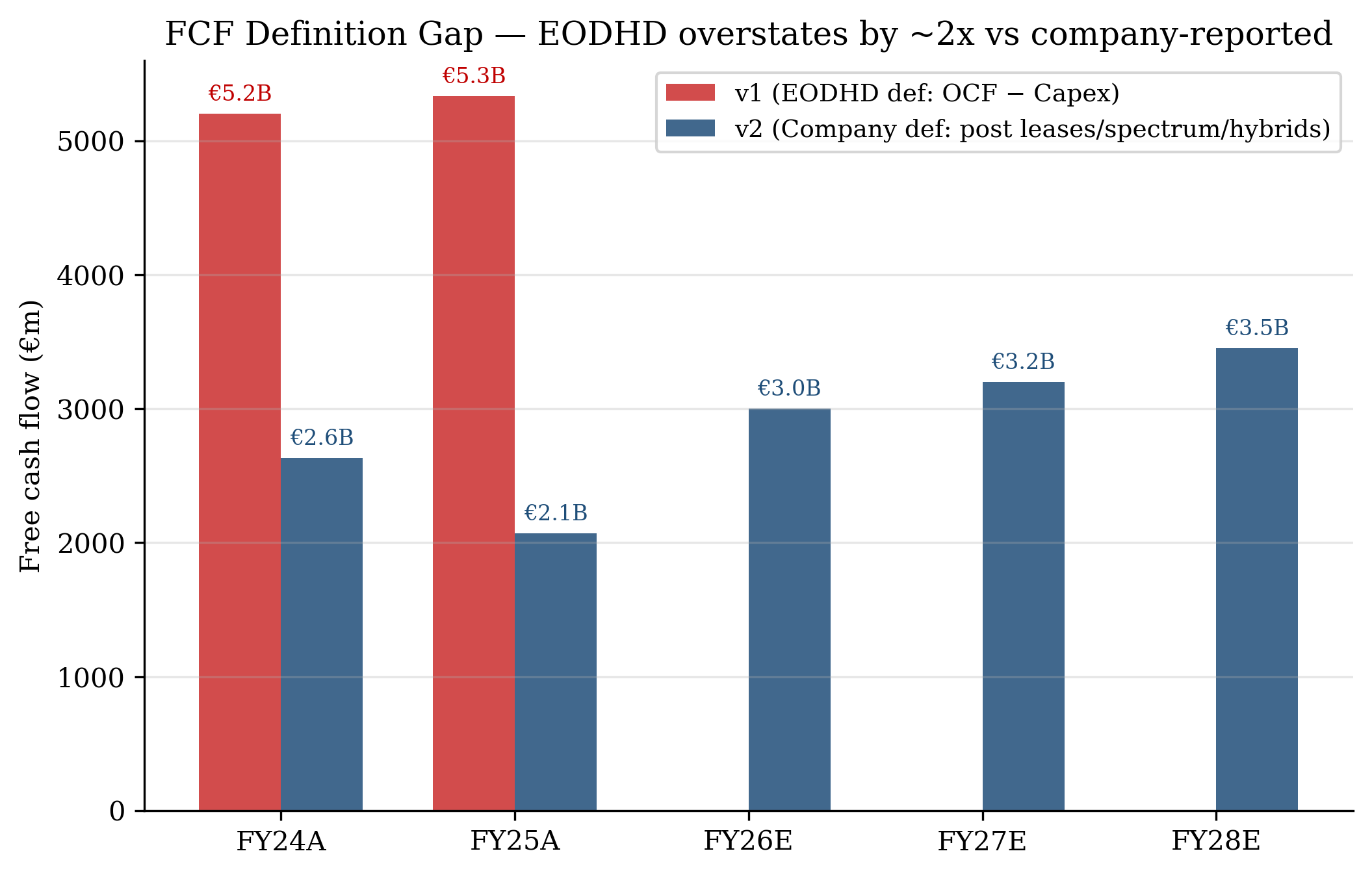
10 tabs, formulas. €3bn FY26E FCF baseline (vs v1 €5.9bn). Dividend reset row. Download xlsx.
Includes new charts on FCF definition gap and v1-vs-v2 PT comparison. Download zip.
Cover, summary, T&G plan, FY25 actuals, segments, valuation, risks, v1 vs v2. Download docx.
Selected v2 charts
What did v2 do differently?
v1 was a credible-looking but factually wrong piece of equity research. v2 incorporated up to date information, adpated the financials for a corporate action and took into account the dividend cut. The shift was down to disciplined upfront fact-gathering and sourcing of up-to-date data.
v2 has gaps. Pension under-funding is a placeholder; perpetual hybrid coupons are illustrative; Brazil dividend repatriation isn’t modelled. A real production initiation would close these from the FY24 20-F or directly from CNMV / IR.
Even from this small exercise, there is recognition that the skill needs an update by having a cutoff guard: 🚨 TRAINING DATA OUTDATED — search before drafting. The fix is at the skill level. I managed to get to a workaround (forcing WebSearch upfront myself). But the easier path is to bake it in. As it would be to adapt the skill to your own personal process.
Practitioner take
This latest version corrects for the issues of v1. The biggest problem is that it was easy to make those initial mistakes through the prompt which produced v1. A clear understanding of what you want produced, the data that supports it and how you are adjusting to your personal needs are all considerations I would spend time adjusting within these skills.
Chapter 5 of 7