Knowing Your Probabilities
What cricket can teach us about value investing — using probability matrices to decompose where stock returns really come from.
The cricket analogy
In cricket, where a bowler pitches the ball has a measurable impact on how many runs the batsman scores. Hitting Against the Spinshows a graphic mapping ball position on the wicket to the batting average in that zone. Dark patches are low numbers — they’re good for the bowler because the batsman isn’t scoring many runs before getting out.
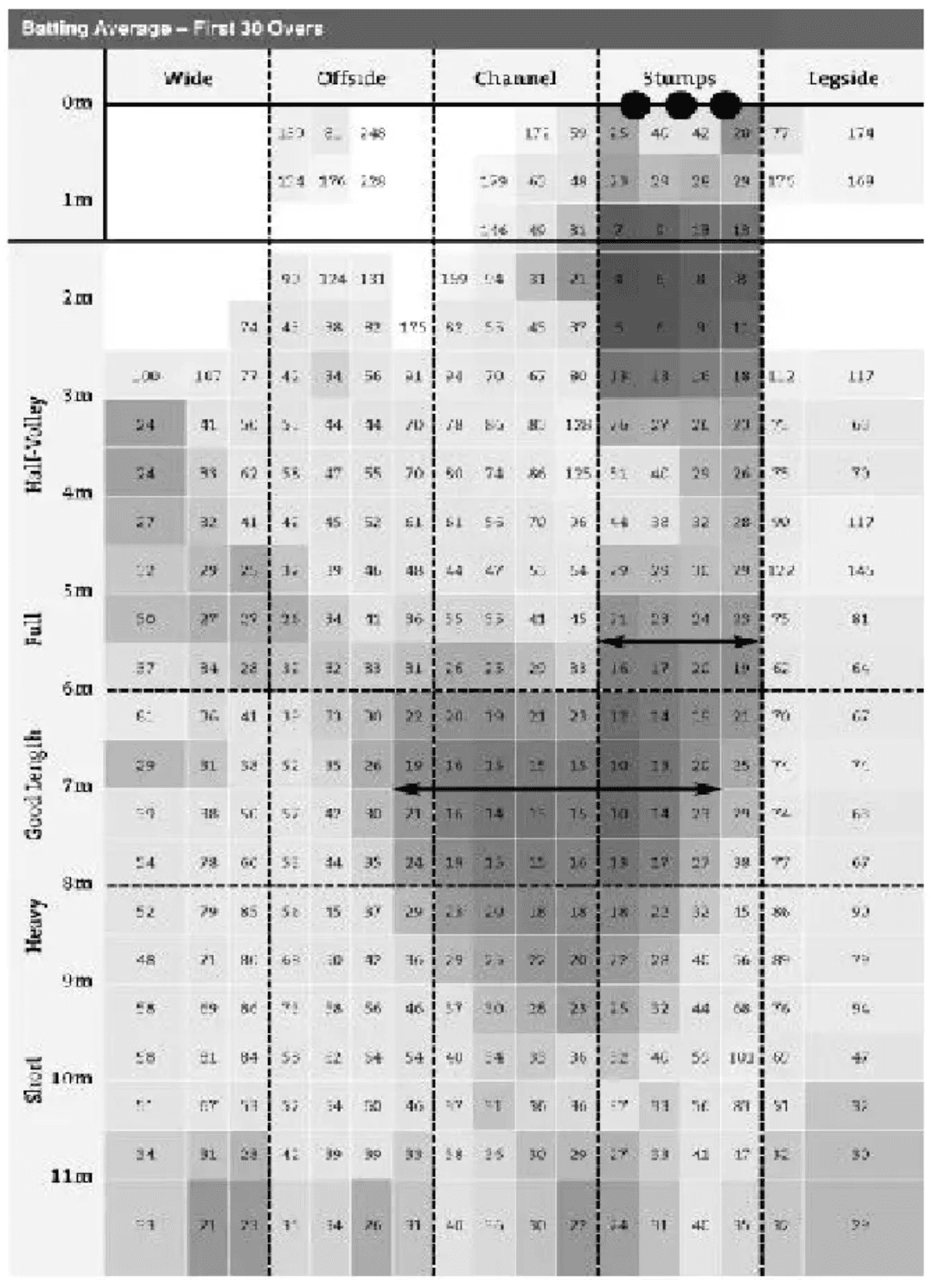
If you are bowling, you want to aim at the darkest patches — a good length on the line of the stumps. People who don’t like cricket are probably wondering “so what?” — and even those who do may be wondering the same thing.
The question is: is there a value investing equivalent of this graphic? If we are a value investor, how likely is it that we are going to make money off buying a cheap company, and what combination of P/E expansion vs earnings growth are we likely to face?
Decomposing value stock returns
Using a dataset of ~56,000 stock-year observations across global markets, we can examine the distribution of 3-year forward returns grouped by starting valuation. The histogram below lets you explore how the distribution shifts as you move from cheap stocks (PE <5x) to expensive stocks (PE 40x+).
The colour coding highlights four outcome bands: severe losses (down more than 20%), below equity-type returns (-20% to +24%), moderate success (+24% to +60%), and stocks which absolutely smash it (+60%+). Watch how the proportions shift across valuation buckets.
What the data reveals
The heatmap above decomposes 3-year returns into their two components: PE change (valuation expansion or contraction) on the x-axis and earnings change on the y-axis. This is the cricket analogy in action — it shows where the ball lands.
Comparing cheap stocks (starting P/E < 5x), medium stocks (around 15x), and expensive stocks (around 25x) across the same framework reveals several conclusions:
- •Focusing solely on returns, it is possible to make money on average even if you are wrong on earnings. The stocks which see earnings fall 30% still generate a positive return on average — driven entirely by P/E expansion.
- •The biggest difference is in P/E changes. Cheap stocks tend to see valuation expansion; expensive stocks tend to see valuation contraction. This is the mean-reversion engine behind value investing.
- •There are consequences in terms of share price return if value investing falls out of favour. This isn't hugely surprising, but it helps quantify the risk of being a value investor during a growth-dominated market.
Implications for stock selection
The probability matrix gives you a framework for thinking about what you are really betting on when you buy a cheap stock. Are you betting on earnings recovery, valuation re-rating, or both? And how likely is each scenario given the base rates?
This connects to the broader theme of knowing your probabilities before you invest. Just as a bowler should know where to pitch the ball to maximise the chance of taking a wicket, a value investor should know the empirical distribution of outcomes for the type of stock they are buying — and be honest about where the most likely landing zone is.
Key Takeaway